


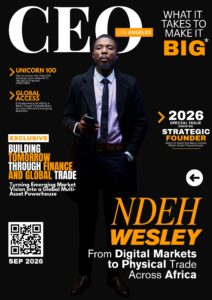

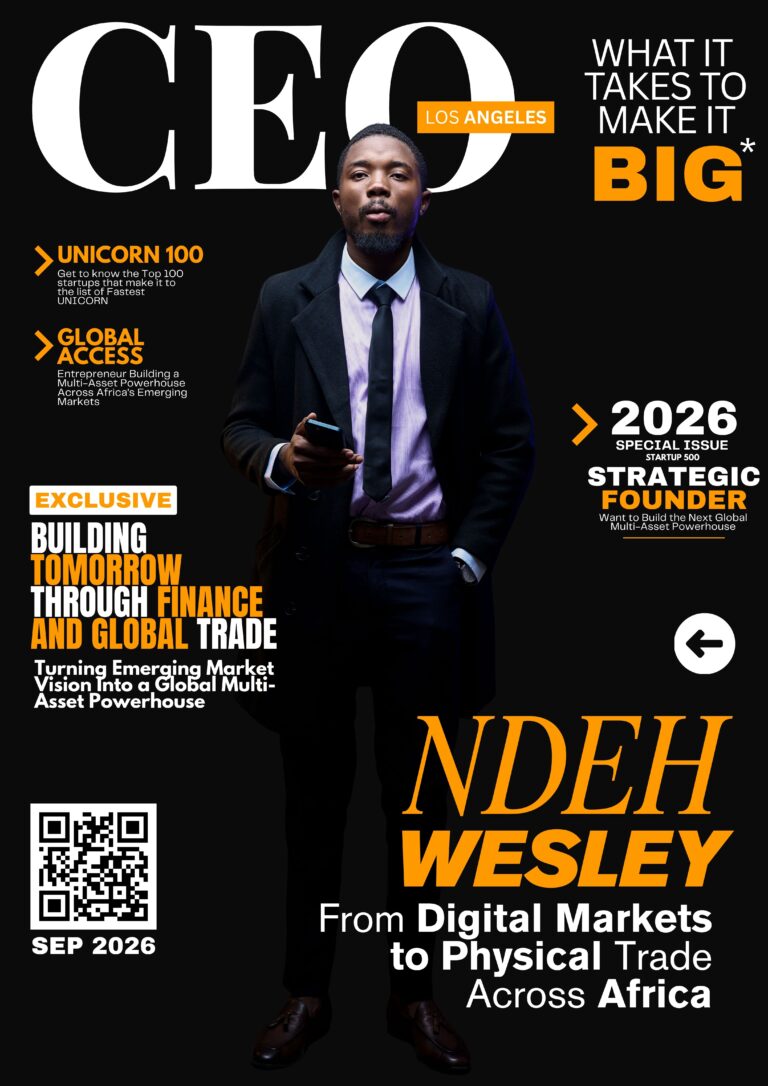
In emerging markets, opportunity often exists where financial innovation meets the realities of physical commerce. For Ndeh Wesley, Founder and Chief Executive Officer of Pirex Assets, that intersection has become the foundation of a broader vision for building resilient, scalable, and institutionally structured trade infrastructure across West and Central Africa.
Wesley is an emerging market strategist and quantitative operator whose work spans financial markets, digital assets, commodities, logistics, and agricultural trade. Through Pirex Assets, he is developing a modern multi-asset platform designed to connect sophisticated financial strategies with tangible economic activity.
His approach is built around a simple but ambitious idea: sustainable wealth creation should not depend on a single market, asset class, or economic cycle.

Instead, Wesley believes that digital market precision and physical asset movement can work together to create stronger and more diversified economic opportunities.
Wesley founded Pirex Assets with the objective of institutionalizing trade execution within emerging economies while creating an operating structure capable of participating across both financial and physical markets.
The company sits at the intersection of decentralized digital assets, global liquid markets, commodities, and regional distribution networks.
Its identity reflects that hybrid approach. Pirex’s foundations include a long-term interest in digital treasury reserves connected to the Pi Network ecosystem alongside active strategies across global Foreign Exchange markets and physical commodity operations.
Rather than treating these markets as unrelated businesses, Wesley views them as complementary components of a wider financial and commercial ecosystem.
This philosophy has shaped Pirex into what he describes as a dual-engine business model, with one side focused on financial market infrastructure and the other centered on commodity trade and logistics.
Within financial markets, Pirex focuses on quantitative analysis, disciplined capital allocation, and systematic risk management.
The company applies structured analytics across FX and equities while emphasizing capital protection as a fundamental part of its operating model.
For Wesley, successful participation in global markets is not simply about identifying opportunities. It requires controlling exposure, managing downside risk, and developing repeatable systems that can perform across changing market conditions.
That disciplined approach also extends to Pirex’s work with retail traders.
The company has introduced trader enablement initiatives designed to make market participation more accessible, including educational resources and an 80 percent commission rebate model.
The objective is to create an environment where traders can gain greater exposure to financial markets while developing a more structured understanding of execution, risk, and capital management.
For Wesley, education and infrastructure are closely connected. Greater access to markets becomes more meaningful when participants also understand the discipline required to navigate them.
While financial markets represent one side of Pirex’s strategy, physical trade forms another major part of Wesley’s long-term vision.
Across the CEMAC and WAEMU regions, Pirex is developing supply chains connecting agricultural producers with commercial buyers and distribution networks.
The company works across categories including livestock, bio-active organic fertilizers, nutrient-dense animal feeds, and farm-gate agricultural produce.
Its role extends beyond basic commodity sourcing. Pirex aims to manage the broader execution process, helping structure movement from production through logistics and ultimately into commercial markets.
In many emerging economies, agricultural opportunity can be significant, but inefficiencies in transportation, distribution, market access, and financing can limit the ability of producers to scale.
Wesley sees infrastructure as one of the keys to unlocking that potential.
By connecting producers more directly with commercial markets, Pirex is seeking to create a system where physical trade becomes more organized, measurable, and commercially efficient.
The combination of financial markets and physical commodities gives Pirex a distinctive operating structure.
Digital markets offer speed, liquidity, data, and global accessibility. Physical commodities offer tangible demand, regional economic relevance, and exposure to essential sectors such as agriculture and food production.
Wesley’s strategy is to bring those two worlds together.
His broader thesis is that long-term wealth generation in emerging markets requires more than digital speculation or traditional commerce alone. It requires combining sophisticated financial execution with economic activity tied to real products, real supply chains, and real demand.
This dual-engine model is also designed to create resilience.
Different markets respond differently to economic cycles. Financial markets can provide liquidity and global exposure, while commodity operations can remain connected to essential regional demand.
By participating across both, Pirex aims to create a more diversified operating foundation.
One of Wesley’s central ambitions is to bring greater structure to sectors that have historically operated through fragmented networks.
For him, building a major emerging market company requires more than pursuing individual transactions.
It requires governance, risk frameworks, documented processes, repeatable systems, and disciplined execution.
These principles are becoming increasingly important as African markets attract greater attention from investors, technology companies, commodity traders, and global institutions.
Wesley believes companies capable of combining local market understanding with formal operating standards will be best positioned to capture that opportunity.
Through Pirex, he is working to build that type of platform.
The goal is not simply to participate in emerging markets, but to develop infrastructure capable of supporting retail participants, commercial operators, producers, and eventually institutional investors.
Africa’s economic landscape is defined by both enormous potential and considerable operational complexity.
West and Central Africa include rapidly growing populations, expanding digital adoption, large agricultural sectors, and increasingly connected regional economies.
At the same time, businesses must navigate logistics challenges, fragmented markets, currency exposure, infrastructure limitations, and differences in regulatory environments.
Wesley’s strategy acknowledges those realities rather than attempting to avoid them.
By combining quantitative financial expertise with hands-on commodity execution, Pirex is building around the conditions that define the markets in which it operates.
Regional expansion remains an important part of the company’s future.
The ambition is to strengthen Pirex’s presence across the CEMAC and WAEMU economic regions while continuing to develop partnerships, supply networks, financial capabilities, and institutional operating standards.

Wesley’s leadership philosophy is centered around execution.
Ideas, technology, and capital all matter, but their value ultimately depends on whether they can be converted into functioning systems and measurable commercial activity.
That mindset influences how he approaches both sides of Pirex.
In financial markets, execution means disciplined risk management, quantitative decision-making, and capital protection.
In physical trade, it means sourcing effectively, managing logistics, delivering products, and ensuring that commercial relationships function consistently.
Across both areas, Wesley emphasizes structure over speculation.
His objective is to build an organization capable of surviving market volatility while continuing to identify opportunities for expansion.
As Pirex continues to grow, Wesley’s long-term goal is to establish the company as a recognized multi-asset platform operating at the intersection of finance, technology, commodities, and regional trade.
The opportunity extends beyond any single asset class.
It is about creating infrastructure that allows capital, information, products, and market participants to move more efficiently across emerging economies.
For Wesley, the future of wealth creation in Africa will increasingly depend on businesses capable of connecting global financial systems with local economic activity.
Through Pirex Assets, he is attempting to build precisely that bridge.
By combining quantitative market strategies with tangible physical trade, formal governance, risk discipline, and regional execution, Ndeh Wesley is positioning Pirex for a larger role in the evolution of Africa’s emerging market economy.
And as the company continues expanding across West and Central Africa, Wesley’s ambition remains clear: build an institution capable of turning market opportunity into enduring economic value.